Can I Upload Cyberlink Photodirector Project With Music to Facebook Post Facebook
More than a decade since the start version was introduced, PhotoDirector 10 gains features as tethered shooting or complex layers in a parcel that can too solve your photo indexing problems.
Which software offers content-aware editing, dehaze, avant-garde layer editing? If you said Photoshop, Lightroom, ON1 Photo RAW, Affinity Photograph or Luminar you're probably correct, but you left out many other names that likewise offer similar features. In fact, we tend to keep to the same names, over and over, and forget that the market has more than options to choose from.
One example is CyberLink's PhotoDirector x, which has all the features mentioned higher up, but many others, some particular to this software. For case, practise you know that PhotoDirector ten offers users things like tethered shooting, ane-click Keystone correction, multiple-exposure shots from video, panoramas from 360 degrees images, AI Style plugins, 360˚ photo editing? Some are completely new, as they were introduced with this new version of the programme.
A serious Library module
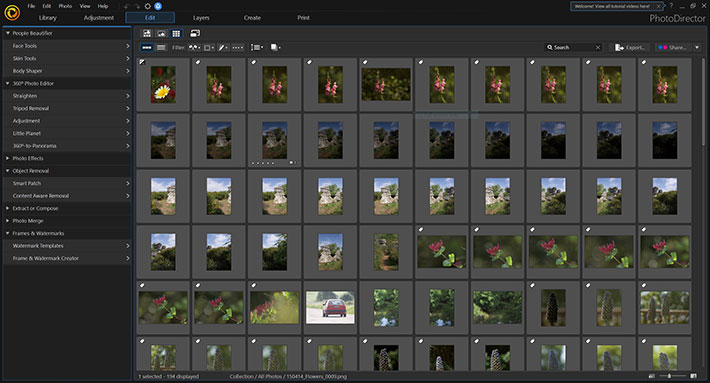
There is more about Photo Director 10, and this hands-on or review will, I promise, help you discover more about the software. Before I continue, though, let me share with you 1 more feature: the library module of Photo Director 10, which is an example of a tool that tackles in a serious way the need to allocate your images.
In a world where keeping track of one's images is an essential feature of whatever plan, PhotoDirector 10 offers a module with two segments, Project and Metadata. The first gives you access to your different HDDs or SSDs and corresponding folders, the mode you've them organized, and allows you to create Projects, Smart Collections, Albums, and Tags to organize images. Now added to the program is a new option, Calendar View, which is something many users seem to employ and CyberLink decided to introduce in this version. It does what the proper name suggests: allows yous to see your images by date, and uses the metadata to automatically organize everything.
From EXIF to IPTC and tags
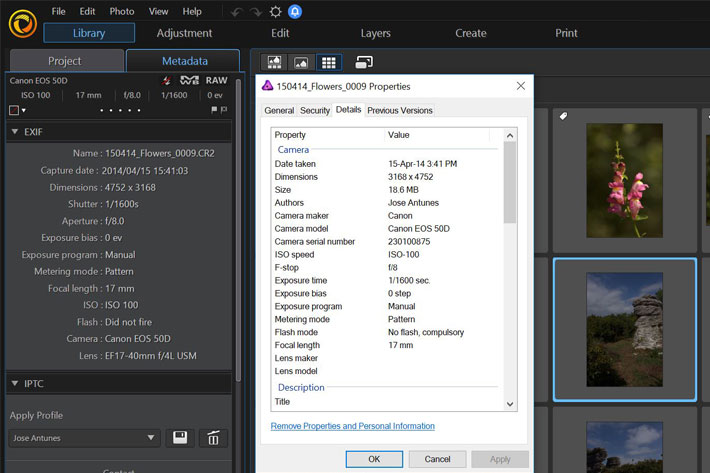
The Library besides allows users to organize images using the now common tools: color, stars and flags. Merely equally long as the EXIF data is recorded in the prototype, at that place are almost space ways to search for images: by camera or lens, shutter, aperture, ISO used, by date, and more. The system is extremely flexible and complete. Information technology does non stop there, though, as the use of tags extends the options available for sorting images.
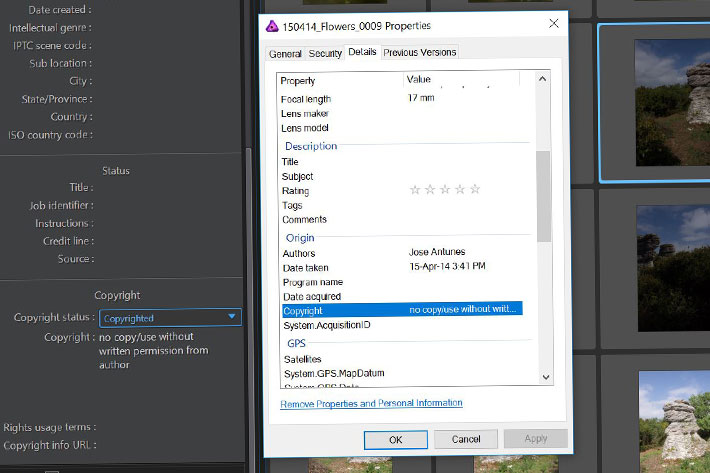
The Metadata section shows all the EXIF data available for each epitome, and here the user discovers another gem: support for IPTC data, the standard from the International Press Telecommunications Quango, used by agencies, newspapers and professional photographers to guarantee that images are distributed with essential information, from author and copyright to location, subject clarification and other information needed. The program will read the information from whatsoever images added to its Library, and besides allows users to create profiles to be used. Hither, over again, the usual problems with compatibility between programs may arise, but substantially, I found PhotoDirector 10 reads the info that is there. Great!
Indexing is key to faster workflows
The Library module in PhotoDirector x is non a DAM as many require (or think they require), just the options available make it more than than enough for the needs of most users, who can blueprint their ain system using the different options available. In fact, it offers more than than many other photo editors available today, something that users looking for a new option should consider. In that location is a trial version of the program to download if you are interested.
While many volition become direct to the editing options of a photo editor, information technology makes sense to start here, at the Library, because that's where people will outset when they first open PhotoDirector ten. The amend yous organize your images when starting, and the program does offering a complete set of tools for that, as I've just demonstrated, the better your workflow will be.
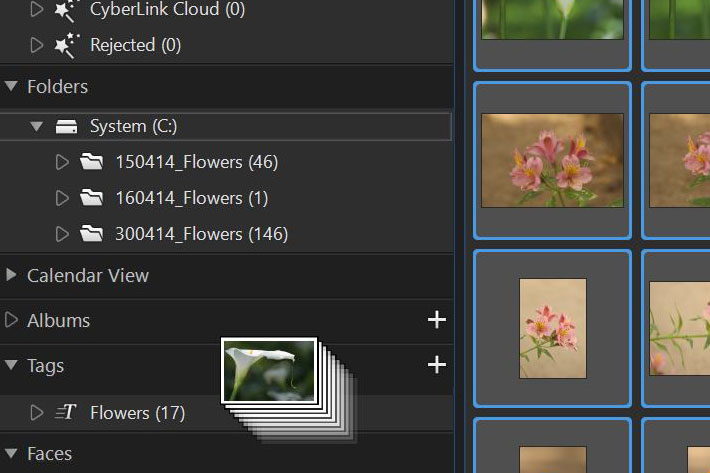
Elevate & Drop and Facial recognition
When tagging groups of images, the programme allows y'all to select them and, if the tag already exists, simply drag and drop the serial of images on the Tags side panel. The program automatically adds the selected tag to all the pictures. If the same group of images too shares another tag, repeating the procedure takes care of all your tagging needs.
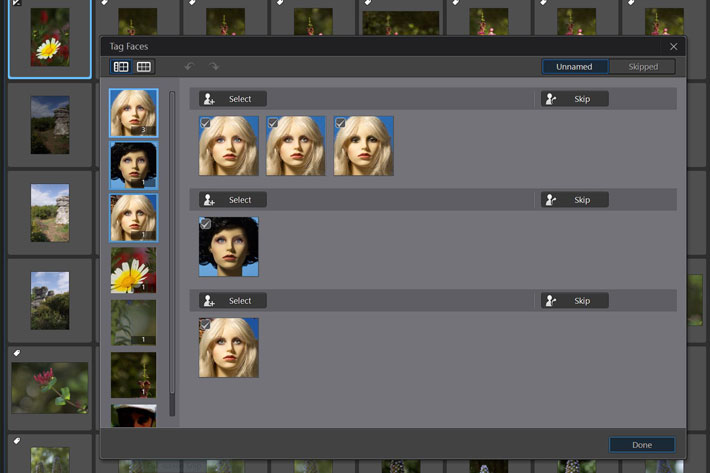 I spent some fourth dimension playing with the different options and even discovered that one tag already present, Faces, works. The plan can identify faces in photographs automatically, and volition allows you to add names to the images institute, something I did during my trials. Although this is not a feature I use, I must admit I was surprised to see how well it worked!
The interface follows the bodily conventions for this type of software, and the popup window explaining each tool or role that appears in one case you movement the mouse over ane icon makes it quick to know your style effectually. Once yous're familiar with all the menus and functions, you can disable the popup. While the panels tin can not be moved, the way the different tools are arranged makes for a fast adaptation to PhotoDirector 10. The viewing options, which allow you to become from the browser and image normal view to a total screen view of the image existence editing and dorsum, in less time than it took to write this note, ostend the intendance taken on building the interface.
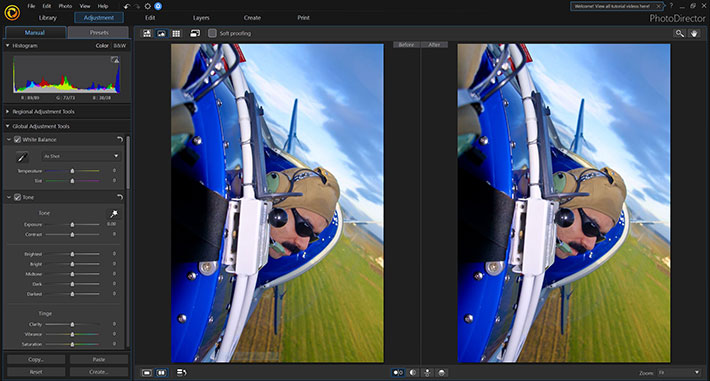
Adjustments has everything you need
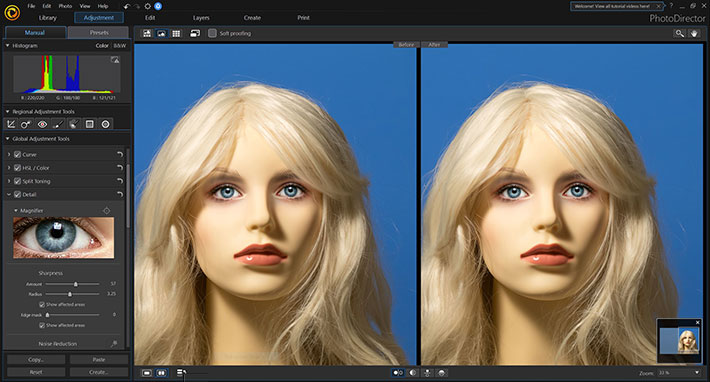
Subsequently the Library, the next step takes us into the editing department of PhotoDirector ten. The Adjustment section comes next in the program, and it is divided in two areas, Transmission and Presets. The kickoff is where y'all'll spend most of the time, editing your photos with all the classic tools you'll find in whatever mod photo editor: White Balance Tone, Levels, Curves, HSL/Colour, Split Toning and HDR Upshot (well it is here, too) and finally Detail, to control sharpness, are all present under Global Adjustment Tools, and you also take Regional Aligning Tools, that allow y'all to introduce changes in areas of the image.
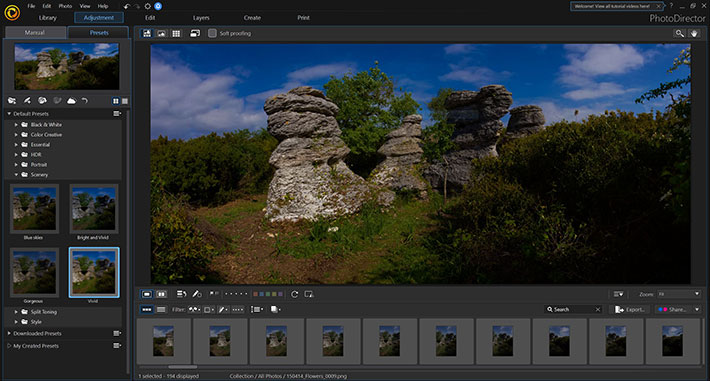
This section also includes the Presets, which take you to canned Presets, from Black & White to Scenery, including also Color Creative, Essential, HDR and Portrait, each offering multiple options. Presets are, as always, something that does not suit every type or image, and you'll probably dislike some of the effects and never use them… although other users will call up otherwise. The good thing nearly Presets is that you lot tin use them equally a base or starting point to edit one image, and you can also create your ain Presets, adjusting the unlike parameters in the Manual fashion, and then saving the event. Or you can simply forget them all!
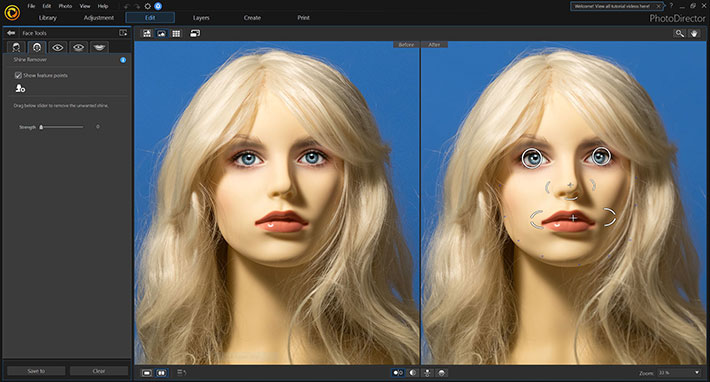
People Beautifier and Face Tools
Presets are also something that CyberLink offers through its Director's Zone space online, an area initially created to share presets for its video editor, PowerDirector, but now used every bit the sharing indicate for the community using the unlike programs. You lot'll find there many presets, transitions, special effects created and shared by users and you can also upload those you create so other users tin try them. Again, you lot'll notice stuff in that location that is of no involvement to you lot, but yous may also discover interesting tricks that will add a nice little touch to some images. I know, considering I've found some!
The Edit section comes next, with a whole serial of options to extend editing into more complex areas. This is where you'll find some tools that deserve more attending and volition justify a closer look at the features PhotoDirector ten offers . Hither you've sections as the People Beautifier, 360 Photograph Editor, Photo Furnishings, Object Removal, Extract or Compose, Photograph Merge, Frames & Watermarks, each opening to sub sections. For example, the People Beautifier offers Face Tools, Skin Tools and Body Shaper, while the 360 Photo Editor opens to tools named Straighten, Tripod Removal, Adjustment, Niggling Planet or 360- to-Panorama.
The Face Tools let you to remove unwanted smooth on skin simply also enlarge optics, remove eye bags, wrinkles, darken the dark area or brighten the eyes and adjust everything from the shape of the face to whitening teeth. There is also a Skin Smoothener and Skin Tone chooser, and finally a Body Shaper, opening to experiences that may exist the verbal answer to the needs of some users.
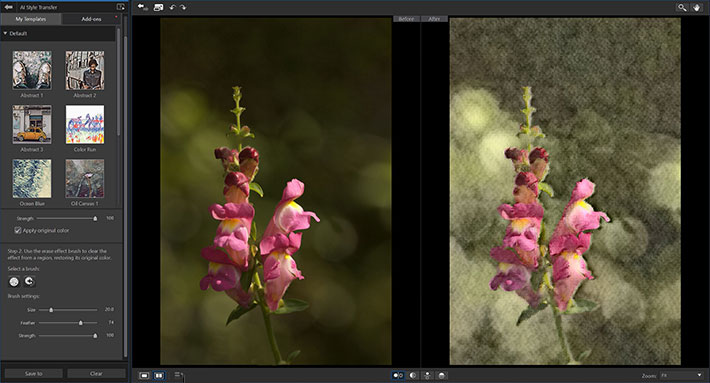
The new AI Style Packs
Nether the Photo Effects you'll find a series of options, including the new AI Manner Transfer, which offers, according to CyberLink, more a regular photograph filter does. AI Way Packs are based on the company's development of AI editing tools and appeared starting time in PowerDirector, earlier this year. According to the company, the "AI Style Plugin uses deep learning to produce piece of work demonstrating a much greater understanding of the idea processes backside how man artists create their masterpieces – right down to castor strokes and colour tones." According to me, these effects will create a painting-like effect that, over again, will entreatment to some users while others will dislike it. Not everybody likes the idea that "your photograph looks like a painting"…
As with everything else, the AI Style Plugin and Style Packs should exist accepted every bit another tool, offering results that may work in some situations. In the modern editing world, where so many programs offer presets and other automated solutions, this is just some other way to edit images. CyberLink has created collections of packs, that tin be acquired past users, and adds them to the new subscription model besides offered equally an alternative to the perpetual license.
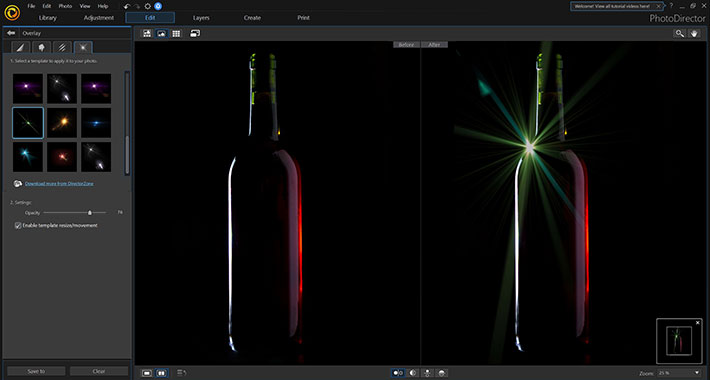
Tethered shooting
You may never want to employ the new AI Style Engine and additional Style Packs that CyberLink believes will revolutionize the creative procedure, simply PhotoDirector x is much more than this feature. In fact, the more I explored, the more I was amazed by 1 aspect of the program: you don't need to jump from software to software to do lots of things. While I do know that many photo editors these days attempt to exist your "universal tool", PhotoDirector ten feels like being shut to accomplish that goal, mixing tools that the general public will use with more professional tools, like, for instance tethered shooting. While tethered shooting is "officially" express to some models from Canon and Nikon, CyberLink says that other camera models, including from other brands, might work, so nothing improve that download the trial version and give it a try.
There are other reasons to utilize the program, though, and creating Panoramas, which appears nether the section Photo Merge is one of them, for me. The process is simple and the results convincing. From Subclass HDR to Multi Exposure or Face Swap, Photo Merge covers everything. The Edit section has other options, including all the tools for Content Enlightened Clone, Motion or Removal.
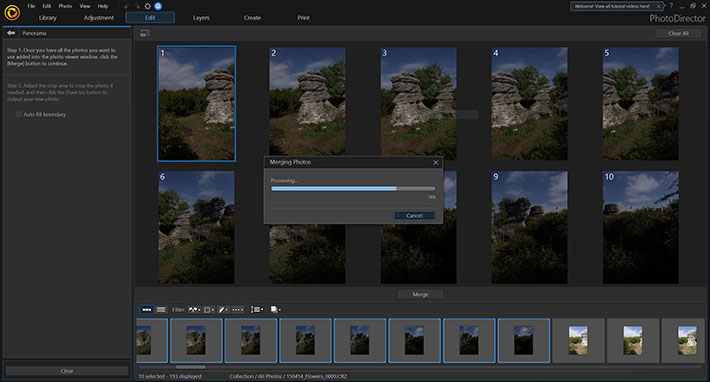
Expanded options for Layers
Layers come up adjacent, and there is a expert reason for information technology to be a completely separate entity. PhotoDirector 10 features a host of improvements to layer editing, allowing more experienced editors greater creative flexibility. From clipping masks, layer grouping and the ability to add together new empty layers to projects, to the pick to edit each layer on its own using adjustments, Layers opens a world of artistic possibilities for users to explore, through an expanded menu which includes options for adding text to blur sections of images.
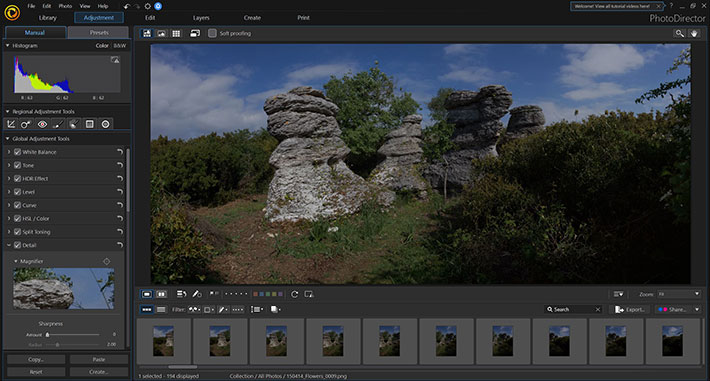 While advanced users volition find that key options are nowadays in Layers, novice users will probably appreciate the collection of built-in Limited Layer Templates, which offer quick creative solutions that may well be a starting bespeak to not only go piece of work done faster, just also learn more near the mode layers piece of work. CyberLink includes some templates but, here again, promises that more packs volition be bachelor for buy through the CyberLink Shop. Packs bachelor now include Lines and Shapes, Galaxy, Teenage, and Comic. One note: this section, as in fact the others, has direct links to tutorial videos showing how to employ the tools, which contributes to make users feel they are never lost.
Cinemagraphs and watermarks
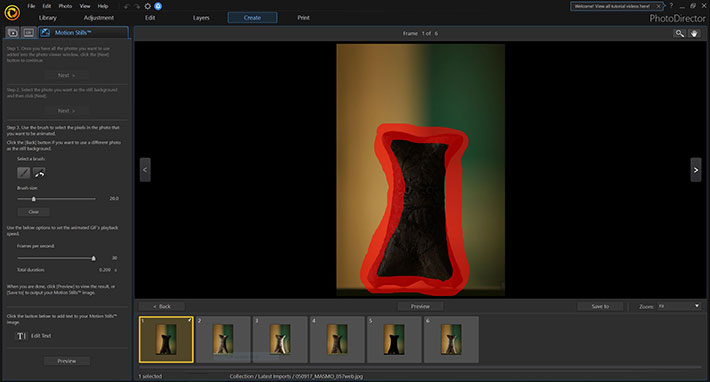
The Create department, which appears next, opens to 3 unlike ways to use your images: Slideshow, Animated GIF and Move Stills. The first allows y'all to create elementary slideshows, and comes with three musical themes to employ with your bear witness. The second creates blithe gifs, as the name suggests, and the third is CyberLink'southward version of Cinemagraphs or Cliplets. You pick a series of images, select the area to exist animated and the program creates a yet image with an animated section. There are other tools offering more than options, but the fact that you take these three in the aforementioned plan is another example of the versatility of PhotoDirector 10.
Frames & Watermarks comes later Photo Merge, and is, once more, a welcome part of the program, as information technology offers a simple solution to what is a headache for many novice users: creating watermarks. The programme offer simple options for frames and lines to identify watermarks, and includes a series of base examples that can be edited. While non a complete solution, it's a welcome improver that I institute useful to quickly creating a watermark to be used with photos.
Soft Proofing for printing
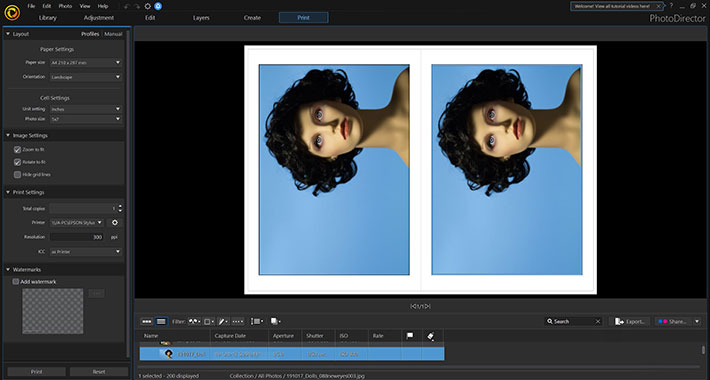
The Impress section offers a simple interface to control press in a diversity of formats, so you can transfer your final edits to photograph paper or other media. Printing comes with a Soft Proofing option, which enables those looking to print their work to preview the specific printer's color and tone rendering and brand any adjustment before creating the physical print. This kind of rounds up an exploration of the program. Under each different section there are many tools and in most cases PhotoDirector includes a History panel that allows you to check all adjustments fabricated, and go dorsum to whatsoever point during the editing process.
Launched final September, PhotoDirector 10 is a huge evolution from the original program, which I've discovered more a decade ago, when the first version was launched. In fact, I even won a Nikon DSLR thanks to the original version of the programme. CyberLink wanted a marketing phrase to promote the software and asked users to send their suggestions, which I did. I was surprised when I received an e-mail stating that I had won!
The evolution of PhotoDirector
In 2013 the programme was already an efficient photograph management system with consummate adjustment and creative editing, and has been developed further in contempo years. With back up for RAW from popular cameras, 64-fleck support and bachelor for both Windows and Mac (which is not a platform for which CyberLink develops its other products), PhotoDirector aims, according to Dr. Jau Huang, CEO of CyberLink, "to demystify photo editing and so that anyone, regardless of their skill level, can create astonishing art from whatsoever shot".
CyberLink's CEO adds that "while nosotros take included some more advanced editing and capture features in this latest version of PhotoDirector, we've held truthful to our mantra of making the seemingly complex rather straightforward." In fact, the program is both adequate for novice and avant-garde photographers, offering everything, from the indexing of photos in multiple ways to features equally Tethered Shooting, and so you don't have to proceed jumping betwixt apps to edit your work. PhotoDirector 10 even offers an option to export images directly to PowerDirector, the NLE from CyberLink, an option that makes sense if y'all use both programs and need to edit images to include in your videos.
A final note
The number of features available makes the app an option I believe some users may desire to consider. Some of the features can stand for a time saving solution in some situations, although yous may observe some of the tools may not be as precise or perfect equally in other software. The Content Aware tools fall into that category, simply then again, no content aware tools are perfect, and PhotoDirector 10, on the other hand, offers other features which may well surprise you, every bit I've discovered. My proffer: download the trial version and explore it the side by side xxx days.
PhotoDirector x Ultra costs $99.99, the alternative being the PhotoDirector 365 version, with a subscription model mentioned here at ProVideo Coalition before. The plan is available online at the CyberLink Store and in selected retail outlets worldwide in the post-obit languages: English language, French, German, Italian, Castilian, Dutch, Chinese (Simplified and Traditional), Japanese and Korean. Every bit mentioned, previously, Windows & Mac versions are available.
Source: https://www.provideocoalition.com/review-photodirector-10-a-photo-editor-with-tethered-shooting-and-dam-library/
0 Response to "Can I Upload Cyberlink Photodirector Project With Music to Facebook Post Facebook"
Enviar um comentário