what does "2/10" mean, with respect to "credit terms of 2/10, n/30"?
Recording Sales of Goods on Credit
When a company sells goods on credit, information technology reports the transaction on both its income statement and its balance sheet. On the income statement, increases are reported in sales revenues, cost of appurtenances sold, and (possibly) expenses. On the remainder sheet, an increment is reported in accounts receivable, a subtract is reported in inventory, and a alter is reported in stockholders' equity for the amount of the internet income earned on the sale.
If the sale is made with the terms FOB Shipping Indicate, the buying of the goods is transferred at the seller's dock. If the sale is made with the terms FOB Destination, the ownership of the goods is transferred at the buyer'southward dock.
In principle, the seller should tape the sales transaction when the ownership of the goods is transferred to the heir-apparent. Practically speaking, nonetheless, accountants typically tape the transaction at the time the sales invoice is prepared and the goods are shipped.
Trick Shipping Point
Quality Products Co. only sold and shipped $one,000 worth of goods using the terms Fob Shipping Point. With its price of appurtenances at 80% of sales value, Quality makes the following entries in its general ledger:
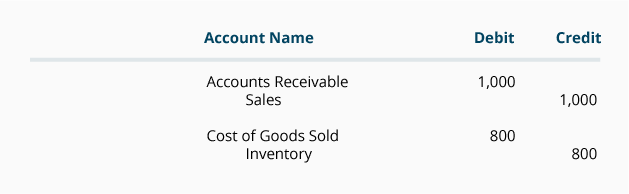
(While at that place may be boosted expenses with this transaction—such as commission expense—nosotros are not because them in our example.)
Fob Shipping Point means the ownership of the goods is transferred to the buyer at the seller'due south dock. This ways that the buyer is responsible for transporting the goods from Quality Product's shipping dock. Therefore, all shipping costs (likewise as any harm that might be incurred during transit) are the responsibility of the buyer.
Trick Destination
FOB Destination ways the ownership of the appurtenances is transferred at the buyer's dock. This ways the seller is responsible for transporting the goods to the client's dock, and will factor in the toll of shipping when it sets its toll for the goods.
Allow'southward presume that Gem Merchandise Co. makes a sale to a customer that has a sales value of $1,050 and a toll of goods sold at $800. This transaction affects the post-obit accounts in Precious stone's general ledger:
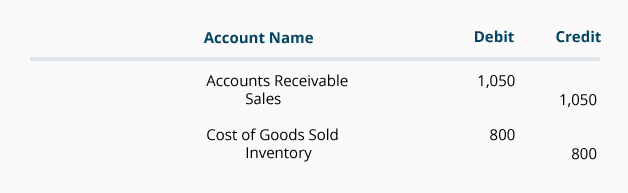
Because Gem chooses to send its goods Pull a fast one on Destination, the ownership of the appurtenances transfers at the buyer's dock. Therefore, Precious stone Merchandise assumes all the risks and costs associated with transporting the goods.
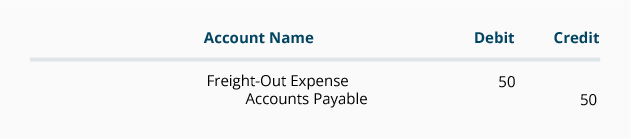
Now let'southward presume that Gem pays an independent shipping company $l to transport the appurtenances from its warehouse to the buyer's dock. Jewel records the $50 every bit an operating expense or selling expense (in an account such as Delivery Expense, Freight-Out Expense, or Transportation-Out Expense). If the shipping company allows Gem to pay in vii days, Gem will brand the following entry in its general ledger:
Credit Terms with Discounts
When a seller offers credit terms of cyberspace 30 days, the net amount for the sales transaction is due xxx days after the sales invoice date.
To illustrate the meaning of cyberspace, presume that Jewel Merchandise Co. sells $ane,000 of goods to a customer. Upon receiving the goods the customer finds that $100 of the goods are not acceptable. The customer contacts Gem and is instructed to render the unacceptable goods. This means that Gem'southward internet sale ends upward being $900; the client's net buy volition also be $900 ($1,000 minus the $100 returned). It likewise means that Jewel's net receivable from this client will be $900.
Unfortunately, companies who sell on credit often detect that they don't receive payments from customers on time. In fact, one written report found that if the credit term is cyberspace 30 days, the money, on average, arrived 45 days later the invoice appointment. In society to speed up these payments, some companies give credit terms that offer a discount to those customers who pay inside a shorter flow of time. The discount is referred to as a sales discount, greenbacks discount, or an early payment disbelieve, and the shorter period of fourth dimension is known as the disbelieve period. For example, the term two/10, internet xxx allows a customer to deduct 2% of the internet corporeality owed if the customer pays within 10 days of the invoice appointment. If a customer does not pay within the discount period of 10 days, the net purchase amount (without the discount) is due 30 days afterwards the invoice date.
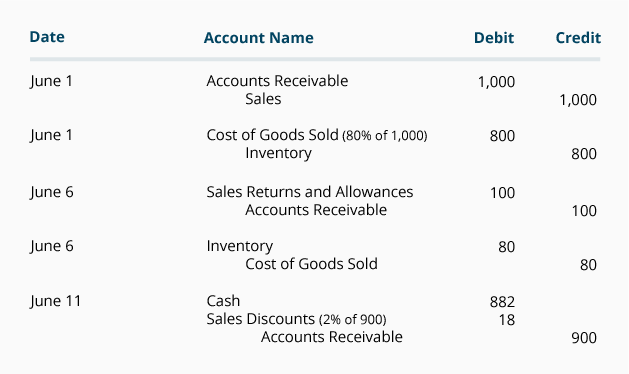
Using the example from above, allow'due south illustrate how the credit term of 2/10, net 30 works. Precious stone Trade Co. ships $1,000 of goods and the customer returns $100 of unacceptable goods to Gem inside a few days. At that bespeak, the cyberspace corporeality owed past the customer is $900. If the client pays Gem within ten days of the invoice date, the client is allowed to deduct $eighteen (2% of $900) from the net purchase of $900. In other words, the $900 corporeality can be settled for $882 if it is paid inside the 10-day discount menstruum.
Let's assume that the sale higher up took place on the first day that Precious stone was open for business, June i. On June 6 Gem receives the returned appurtenances and restocks them, and on June 11 it receives $882 from the buyer. Gem's cost of goods is 80% of their original selling prices (before discounts). The to a higher place transactions are reflected in Precious stone'south general ledger every bit follows:
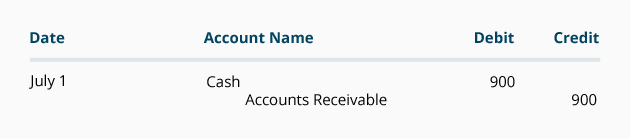
If the client waits 30 days to pay Gem, the June 11 entry shown to a higher place will non occur. In its place will exist the following entry on July 1:
Examples of Amounts Due Under Varying Credit Terms
The following chart shows the amounts a seller would receive under various credit terms for a merchandise sale of $1,000 and an authorized return of $100 of goods.
| Credit Terms | Brief Description | Amount To Exist Received |
| Net 10 days | The cyberspace amount is due within 10 days of the invoice date. | $900 |
| Net 30 days | The internet corporeality is due within 30 days of the invoice date. | $900 |
| Net 60 days | The net amount is due within 60 days of the invoice date. | $900 |
| 2/10, due north/thirty | If paid within ten days of the invoice date, the buyer may deduct ii% from the net amount. ($900 minus $18) | $882 |
| 2/ten, northward/30 | If paid in xxx days of the invoice date, the net amount is due. | $900 |
| 1/10, n/60 | If paid within ten days of the invoice appointment, the buyer may deduct 1% from the net amount. ($900 minus $nine) | $891 |
| 1/10, north/60 | If paid in 60 days of the invoice date, the net amount is due. | $900 |
| Net EOM 10 | The net amount is due inside ten days afterward the stop of the month (EOM). In other words, payment for any sale fabricated in June is due by July ten. | $900 |
Costs of Discounts
Some people believe that the credit term of 2/10, net xxx is far too generous. They argue that when a $900 receivable is settled for $882 (simply because the customer pays xx days early) the seller is, in effect, giving the buyer the equivalent of a 36% annual interest charge per unit (2% for 20 days equates to 36% for 360 days). Some sellers won't offer terms such as 2/10, net thirty considering of these loftier percentage equivalents. Other sellers are discouraged to find that some customers take the discount and ignore the obligation to pay within the stated disbelieve menses.
Source: https://www.accountingcoach.com/accounts-receivable-and-bad-debts-expense/explanation/2
0 Response to "what does "2/10" mean, with respect to "credit terms of 2/10, n/30"?"
Enviar um comentário